
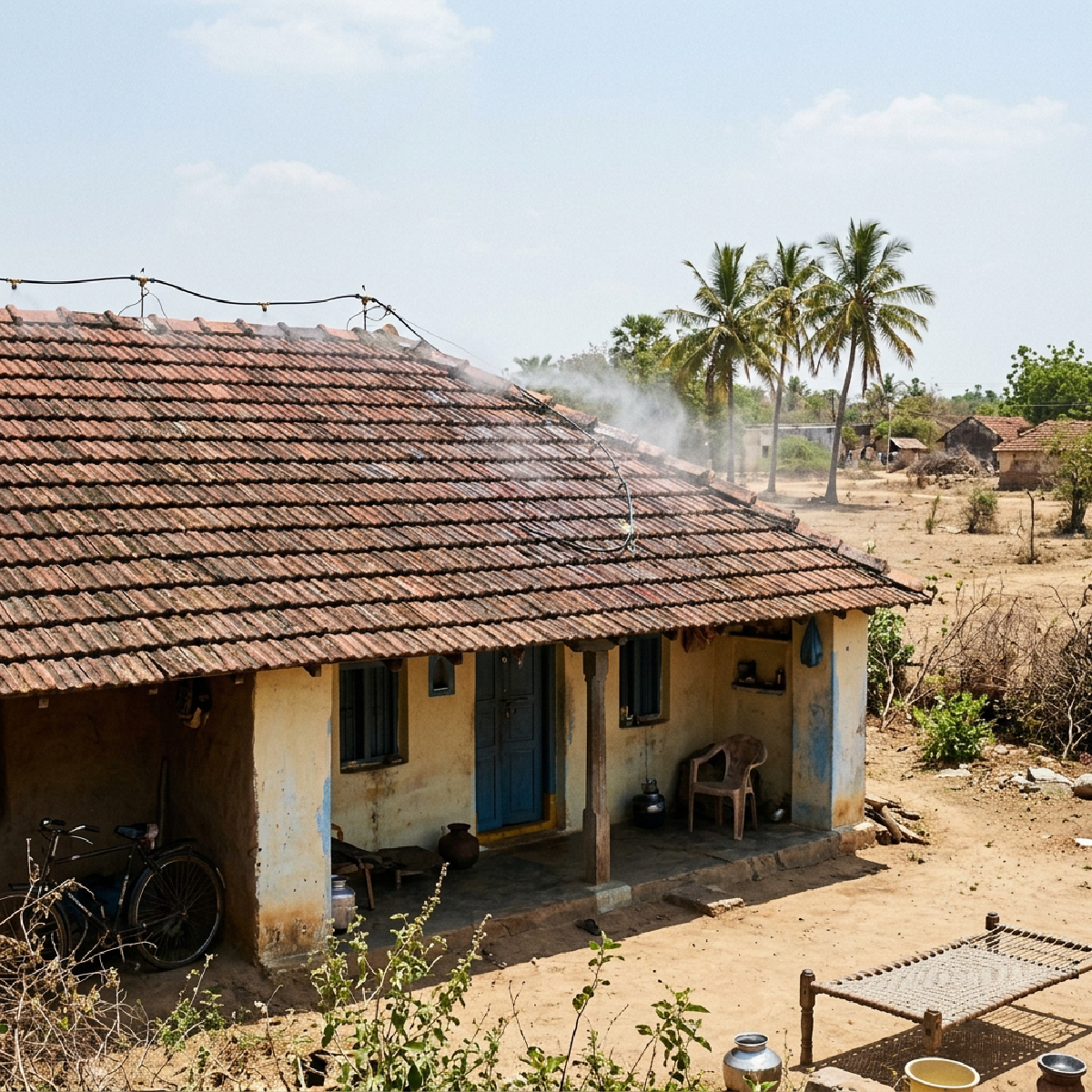

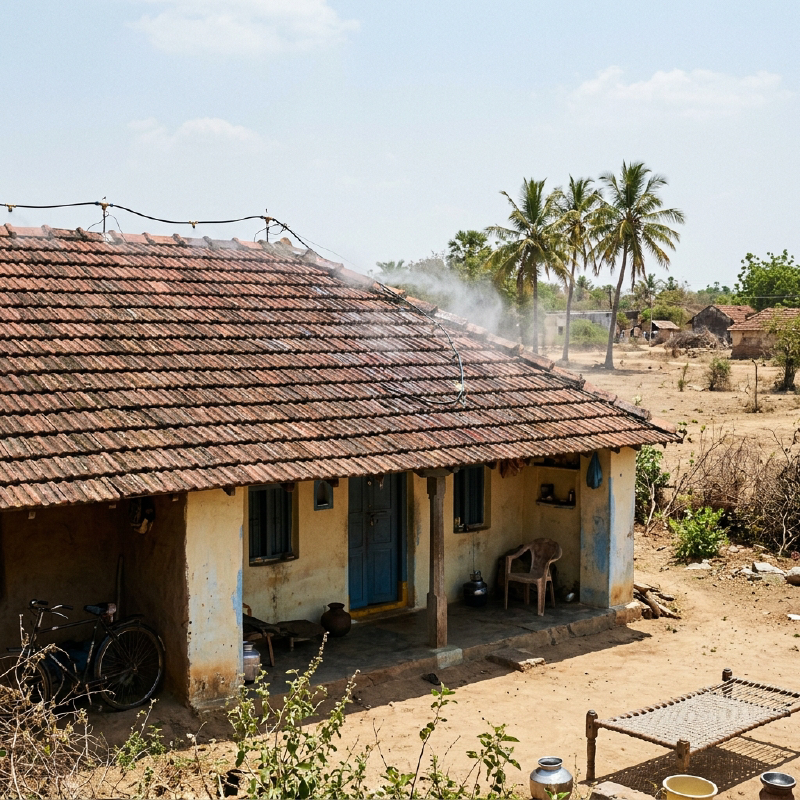
The summer of 2024 didn’t just break records in South India; it broke the equilibrium of traditional climate-responsive architecture. In the arid belt of the Coimbatore region—specifically Sultanpet and Sulur—ambient temperatures frequently peaked at 42°C. For those living in homes with traditional terracotta (Mangalore or Calicut) tiled roofs, the primary thermal challenge is radiant heat. These tiles act as a thermal battery, absorbing solar energy all day and radiating it directly into the living space.
By mid-afternoon, the “clay oven” effect makes the interior almost unlivable, even with air circulation.
The Theory: Latent Heat of Vaporization#
The most efficient way to remove heat from a surface is through phase change. Terracotta, being naturally porous, is an ideal substrate for surface-level evaporative cooling. By applying a fine mist of water to the exterior during peak solar hours, we can take advantage of the latent heat of vaporization (roughly 2260 kJ/kg).
As the water evaporates from the tile surface, it pulls thermal energy directly from the terracotta. This prevents the heat from ever reaching the interior air, unlike indoor misting fans which often lead to uncomfortable humidity levels without actually lowering the building’s thermal load.
Technical Implementation#
The goal was to build a high-pressure, low-flow system using ubiquitous, scavenged components.
1. Pressure Source: The RO Booster Pump#
Standard garden hoses or low-pressure pumps are ineffective for misting; they create droplets that are too large, leading to runoff and water waste. I used a 100 GPD Reverse Osmosis (RO) booster pump. These are designed for high-pressure operation (70-100 PSI) and run on 24V DC.
At a power consumption of approximately 35-40 Watts, these pumps are significantly more energy-efficient than air conditioning units and can be easily integrated with a standard household adapter or a small solar setup.
2. Distribution and Misting#
- Nozzles: Brass or high-grade plastic agricultural misting nozzles with a 0.3mm orifice were used to achieve a fine aerosol.
- Plumbing: 1/4-inch PU tubing (RO grade) provided the necessary flexibility and pressure resistance.
- Fixtures: Push-fit connectors and UV-resistant zip ties were used to anchor the line along the roof ridges.
- Filtration: An inline sediment filter was mandatory to prevent borewell grit from damaging the pump’s diaphragm.
Operational Results#
The system was activated between 11:30 AM and 4:00 PM, the window of maximum solar gain. While I did not perform laboratory-grade temperature logging, the subjective difference was profound. The radiant “sting” from the ceiling vanished. When paired with standard ceiling fans, the interior stayed at a manageable temperature, even as the outside air shimmered with heat.
The Bottleneck: Mineral Scaling#
The primary failure mode for this prototype was water quality. The Coimbatore region relies heavily on hard borewell water. Within weeks, calcium and magnesium deposits began to scale the fine orifices of the nozzles.
Without a serious demineralization stage or a high-grade softener, maintenance becomes a significant overhead. For a permanent installation, a solenoid-controlled auto-flush system or an ion-exchange softener would be required to ensure nozzle longevity.
Environmental Reflection#
While this project was a successful technical intervention, it highlights a larger ecological deficit. The extreme heat in the Sultanpet region is exacerbated by the loss of old-growth canopy to monoculture cash crops. Surface-level misting is an effective “band-aid,” but re-establishing the natural canopy remains the only truly sustainable strategy for thermal comfort in the region.
This article is a refined summary of a series of personal experiments. For a more narrative account of the build process, including the frustrations of sourcing parts in rural Coimbatore, you can read the original posts on my personal blog: