
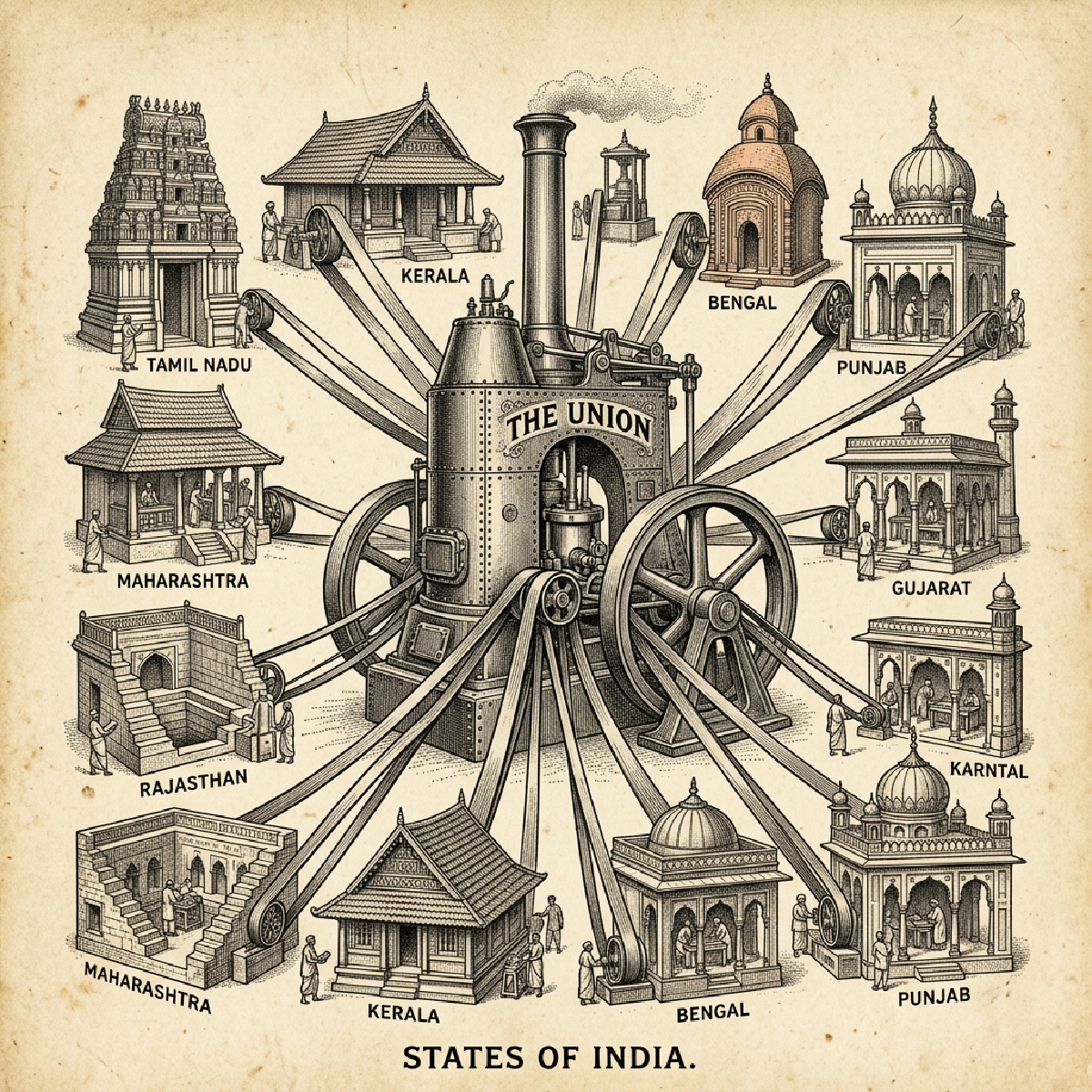

India is a "Union of States," a constitutional definition that acknowledges the vast cultural, linguistic, and socioeconomic diversity across its borders. However, the operational reality of the republic has shifted toward a centralized model that increasingly favors administrative uniformity over local agency.
To ensure long-term stability and effective governance, we must re-examine the structural balance between the Union and the States, specifically regarding the "One Nation, One Election" (ONOE) debate and the systemic encroachment on the Concurrent List.
The Efficiency Trap: One Nation, One Election#
The push for simultaneous elections is often framed through the lens of administrative efficiency—reducing costs and minimizing the disruption of the "Model Code of Conduct." While these are valid operational concerns, they ignore the fundamental political cost: the "nationalization" of local issues.
The Steamroller Effect#
When state and national elections are merged, local grievances—such as regional infrastructure, water management, or state-level policy failures—are often flattened by national narratives. Voters are caught in a single, high-decibel media wave manufactured in the capital, leading them to vote for a "vibe" rather than a local representative.
Simultaneous elections mechanically guarantee that the "High Command" can leverage a national mandate to bypass local accountability. In a healthy federalism, staggered elections serve as constant, localized feedback loops that keep the ruling party accountable. ONOE turns this dynamic into a five-year "vacation" from accountability, favoring political monopolies over democratic plurality.
The Case for Radical Decentralization#
The current distribution of powers, defined by the Union and Concurrent lists, has seen a steady migration of authority toward the center. This centralization is reaching a point of diminishing returns, where the decisions for local neighborhoods are made in sterile offices thousands of kilometers away.
Defining the Core Mandate#
For a nation as fragmented and diverse as India, a one-size-fits-all policy framework is inherently inefficient. A radical but necessary path forward involves stripping the Union government’s mandate down to its three core responsibilities:
- Defense
- Foreign Policy
- Currency
Empowering the States#
Every other domain—education, agriculture, health, law enforcement, and local infrastructure—should be transitioned entirely to the states. Currently, the Union government acts as a "glorified sarpanch," promising toilets and local electricity connections from a national podium. This not only burdens the center with micro-management but also reduces state assemblies to administrative shells that must beg for shares of their own tax revenue.
True accountability requires that politicians be within "choking distance" of their constituents. When funding formulas and policy directives depend on a centralized bureaucracy, local agency is erased. Decentralization is not just a political preference; it is a prerequisite for the survival of a diverse republic.
Conclusion: Diversity vs. Uniformity#
The drive for uniformity—whether through synchronized elections or centralized schemes—threatens to turn India’s democracy into a standardized franchise, devoid of the local "flavor" that makes it resilient. Maturity in governance lies in recognizing that the Union is strongest when its constituent states are most autonomous. We must choose between the "efficiency" of a monolith and the "resilience" of a federation.
This article is a refined summary of a series of arguments on federalism. For the raw, visceral manifesto on decentralization and the critique of simultaneous elections, you can read the original posts on my personal blog: