
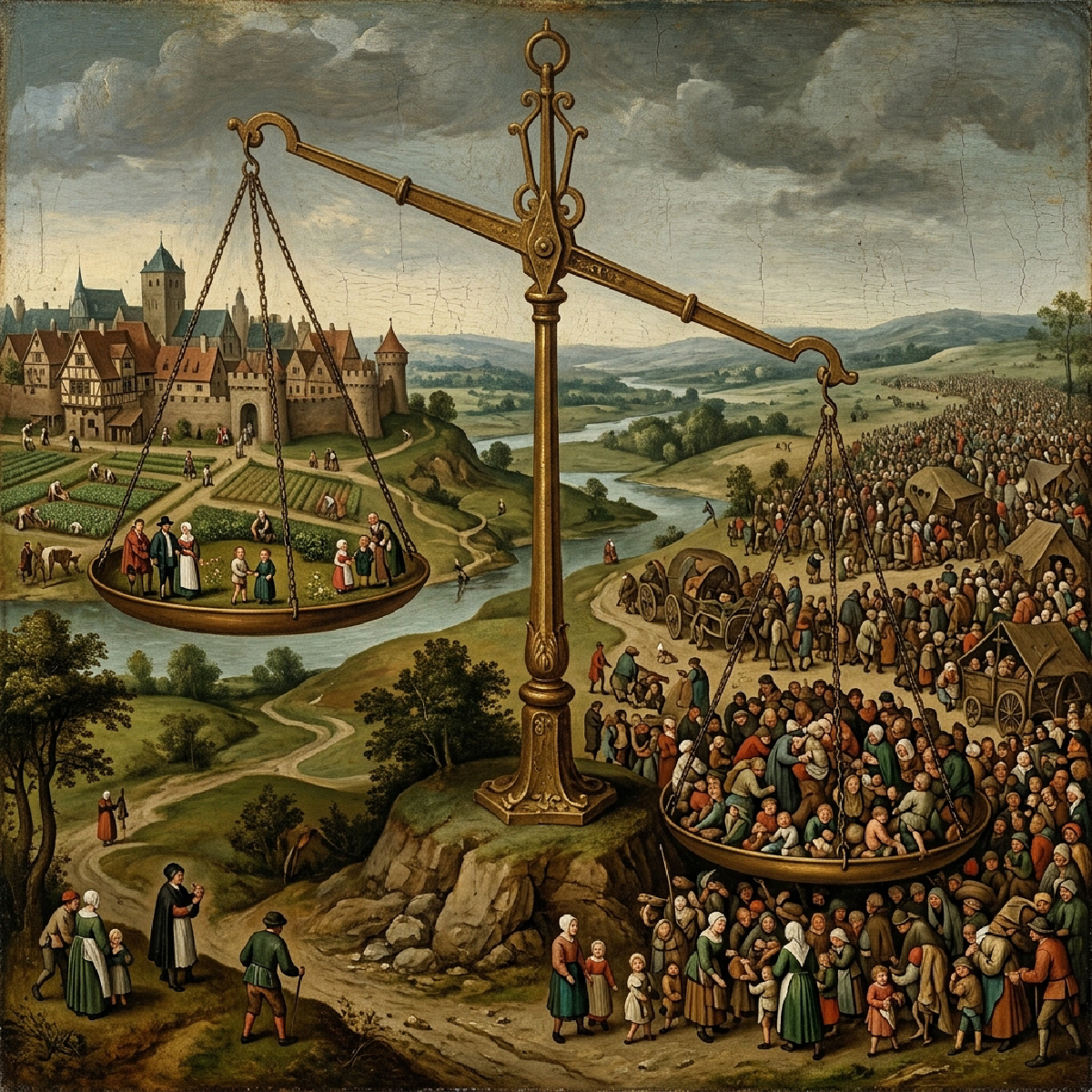

The social contract of a federal union is built on the premise of mutual benefit and collective progress. However, in India, a structural crisis is brewing at the intersection of population growth and political representation. As we approach the 2026 deadline for the reapportionment of parliamentary seats, the “Demographic Penalty” is emerging as a critical threat to the stability of the union.
This penalty is a mechanical outcome of a system that rewards administrative failure with increased political power, while penalizing states that have successfully implemented national mandates on human development and family planning.
The Success Trap: A History of the Freeze#
In 1976, the Indian government recognized that if Lok Sabha seats were continuously redistributed by population, states would be incentivized to increase their headcount to maintain political leverage. To decouple population growth from political power, a freeze was implemented based on the 1971 Census.
States like Tamil Nadu and Kerala took this mandate seriously. Through education, women’s empowerment, and robust public health initiatives, they successfully transitioned to a stable demographic model. Their reward was the promise that their political voice in Delhi would not be diminished by their success.
The 2026 Delimitation Crisis#
That freeze is set to expire after 2026. If the Lok Sabha is redrawn based on current population figures, the political map of India will undergo a seismic shift.
- The Southern Penalty: States that successfully controlled their population will see their parliamentary representation shrink. Tamil Nadu, for instance, is projected to drop from 39 seats to approximately 32.
- The Northern Dividend: States that failed to implement family planning mandates—notably the Hindi belt—will see their seat counts swell. Uttar Pradesh and Bihar will gain massive political dominance.
This creates a grotesque incentive structure: competence is penalized, while the inability to manage demographic growth is rewarded with the keys to the Union’s legislative agenda.
Fiscal Asymmetry: Subsidizing Failure#
This political erasure is compounded by a profound fiscal imbalance. In a federal system, wealthier regions often subsidize poorer ones. However, in India, this subsidy has become an extraction racket.
For every one rupee Tamil Nadu contributes to the central tax pool, it receives roughly 40 paise in return. In contrast, states like Bihar receive nearly ₹4.00 for every rupee contributed. While regional equity is a noble goal, the social contract implies that subsidies should help poorer states “catch up.” After decades of massive transfers, the North remains demographically unchecked and economically stagnant, yet it is about to be granted absolute political dominion over the very states funding its survival.
The Colonial Analogy: Taxation without Representation#
If a central authority extracts wealth from a productive region, uses it to fund a population surge in another region, and then uses that surge to systematically reduce the productive region’s political voice—the relationship is no longer federal. It is colonial.
By 2026, the North could potentially form a national government without requiring a single mandate from the South. At that point, the South becomes a political colony: an economic engine with no hand on the steering wheel, funding a legislative agenda it no longer has the votes to influence.
Conclusion: Rebuilding the Machine#
The “Broken Machine” of Indian politics is not a glitch; it is a structural reality. To ignore the demographic penalty is to invite systemic instability. True federalism requires a system where every citizen’s voice has weight, but where no state is penalized for contributing to the national good. Until we decouple brute headcount from supreme authority, the union remains a hostage to its own failed demographics.
This article is a refined synthesis of a series on the structural deficits of the Indian republic. For the raw, visceral accounts of the demographic and fiscal traps, you can read the original posts on my personal blog: